
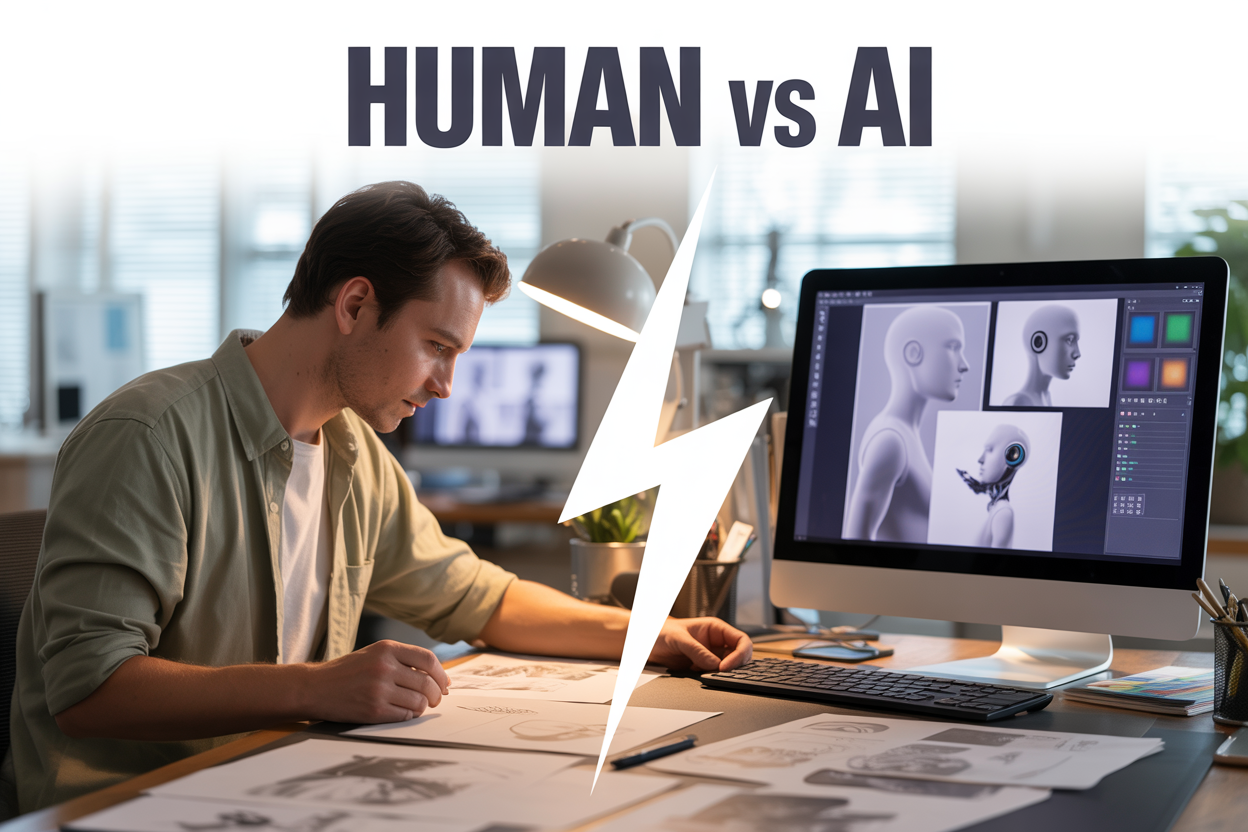
Creative problem solving has become the ultimate battleground between human minds and artificial intelligence. Business leaders, creative professionals, and technology enthusiasts are asking the same question: can machines really outthink humans when it comes to innovative solutions?
This analysis is for anyone curious about how AI stacks up against human creativity in real problem-solving scenarios. You’ll get insights whether you’re a manager deciding on team structures, a creative professional wondering about job security, or simply someone fascinated by the AI revolution.
We’ll break down the unique strengths humans bring to creative challenges versus AI’s computational advantages. You’ll also see how real-world performance plays out across different industries and why the most successful approach might actually combine both human intuition and machine processing power.
The stakes are high, and the results might surprise you.
Understanding Creative Problem Solving in the Modern Era

Defining creative problem solving and its key components
Creative problem solving represents the mental process of discovering original solutions to complex challenges that don’t have obvious answers. Unlike routine problem solving, which relies on established procedures and known methods, creative problem solving demands fresh thinking, unconventional approaches, and the ability to connect seemingly unrelated ideas.
The process typically involves several key components working together. Divergent thinking allows us to generate multiple potential solutions by exploring various angles and possibilities. Convergent thinking helps evaluate and refine these ideas into practical solutions. Pattern recognition enables the identification of underlying structures and relationships that might not be immediately apparent. Flexibility allows for shifting perspectives and adapting approaches when initial attempts don’t work.
Creative problem solving also requires tolerance for ambiguity – the ability to remain comfortable when dealing with unclear or incomplete information. Many breakthrough solutions emerge from this uncertainty rather than from clearly defined parameters. The process often involves incubation periods where subconscious processing occurs, leading to those “aha!” moments when solutions suddenly become clear.
Cross-domain knowledge transfer plays a crucial role, where insights from one field spark innovations in completely different areas. This explains why diverse experiences and interdisciplinary thinking often lead to the most creative solutions.
Why creative problem solving matters more than ever
Today’s challenges are increasingly complex and interconnected, making traditional linear thinking insufficient for addressing them effectively. Climate change, global supply chain disruptions, social inequality, and technological disruption all require innovative approaches that go beyond conventional wisdom.
The speed of change in modern society means that yesterday’s solutions quickly become obsolete. Organizations that rely solely on established methods find themselves struggling to adapt when market conditions shift rapidly. Companies that embraced creative problem solving during the COVID-19 pandemic – pivoting business models, finding new revenue streams, and reimagining customer relationships – often thrived while others faltered.
Information overload presents another challenge where creative problem solving becomes essential. With vast amounts of data available, the ability to synthesize information creatively and identify meaningful patterns separates successful individuals and organizations from those that get lost in analysis paralysis.
Competition has become global and instantaneous. A startup in any corner of the world can disrupt established industries overnight. This reality demands constant innovation and creative thinking just to maintain relevance, let alone achieve growth.
Consumer expectations have also evolved dramatically. People expect personalized experiences, sustainable solutions, and products that address their specific needs. Meeting these expectations requires creative approaches to design, manufacturing, and service delivery that weren’t necessary in previous decades.
The evolution from purely human creativity to human-AI collaboration
The landscape of creative problem solving has transformed dramatically over the past decade. Where humans once worked in isolation or small teams, we now operate alongside artificial intelligence systems that can process information, identify patterns, and even generate novel ideas at unprecedented scales.
This shift began subtly with simple automation tools but has accelerated into sophisticated AI systems capable of contributing meaningfully to creative processes. Machine learning algorithms now analyze vast datasets to identify trends and opportunities that human minds might miss. Natural language processing enables AI to understand context and generate written content that sounds increasingly human-like.
Generative AI has reached a tipping point where it can create original artwork, write compelling narratives, compose music, and even develop software code. These capabilities don’t replace human creativity but rather augment it in ways that were unimaginable just a few years ago.
The most significant change lies in how problems are approached. Humans traditionally relied on intuition, experience, and collaborative brainstorming. Now, AI can rapidly explore thousands of potential solutions, test scenarios through simulation, and provide data-driven insights that inform human decision-making.
This evolution has created new hybrid workflows where humans define problems, set parameters, and provide strategic direction while AI handles computational heavy lifting, pattern analysis, and iterative testing. The result is faster problem identification, more comprehensive solution exploration, and implementation strategies that leverage both human wisdom and machine efficiency.
The creative process itself has become more iterative and experimental, with AI serving as a tireless collaborator that never gets fatigued and can work across multiple solution paths simultaneously.
Human Strengths in Creative Problem Solving

Emotional Intelligence and Empathy-Driven Solutions
Humans possess an unmatched ability to understand and respond to emotional needs, making them exceptional at crafting solutions that truly resonate with people. When tackling problems, humans naturally consider the feelings, motivations, and psychological impacts on everyone involved. This emotional awareness leads to creative solutions that don’t just work technically—they feel right to the people using them.
Take healthcare innovation as an example. Human designers often create medical devices and treatment approaches by imagining themselves or their loved ones as patients. This emotional connection drives them to consider comfort, dignity, and fear reduction alongside medical effectiveness. AI might optimize for clinical outcomes, but humans create solutions that address the whole human experience.
The same principle applies in workplace problem-solving. When teams face conflicts or productivity challenges, human leaders draw on their understanding of interpersonal dynamics, stress responses, and individual personalities. They craft solutions that account for how people will actually behave, not just how they should behave according to data.
Intuitive Leaps and Breakthrough Thinking
Human creativity shines brightest in those “aha!” moments that seem to come from nowhere. These intuitive leaps often connect seemingly unrelated concepts in ways that surprise even the problem-solver. While AI excels at finding patterns in existing data, humans can make wild connections between their morning coffee experience and a breakthrough in urban planning.
This breakthrough thinking often happens when humans are relaxed or engaged in unrelated activities. The famous story of Archimedes discovering water displacement in his bath demonstrates how human minds continue working on problems subconsciously, suddenly producing insights that bypass logical step-by-step reasoning.
Modern examples include designers who solve complex user interface problems by drawing inspiration from nature, or engineers who revolutionize manufacturing by applying principles they learned from cooking. These cross-domain insights happen because human brains naturally form unexpected associations between stored memories and experiences.
Cultural Context and Lived Experience Advantages
Every human brings a unique collection of cultural background, personal experiences, and social perspectives to problem-solving situations. This diversity becomes a powerful creative asset when tackling complex challenges that affect real communities and cultures.
Consider urban planning challenges in different neighborhoods. Human planners who have lived in similar communities understand subtle social dynamics, cultural preferences, and unspoken needs that data alone cannot capture. They recognize that a playground design successful in one cultural context might completely fail in another due to different family structures, social norms, or safety concerns.
Business problems also benefit from this cultural intelligence. When companies expand into new markets, human insight helps navigate cultural nuances that could make or break a product launch. Understanding local humor, social hierarchies, communication styles, and value systems requires the kind of lived experience that humans naturally possess.
Adaptability in Ambiguous Situations
Real-world problems rarely come with clear parameters or complete information. Humans excel at working with incomplete data, changing requirements, and situations where the problem itself keeps evolving. This adaptability comes from years of navigating uncertainty in daily life.
When facing ambiguous challenges, humans can quickly shift strategies, reframe problems entirely, or work with rough approximations while gathering more information. They’re comfortable making decisions with 60% of the information if waiting for complete data would mean missing important opportunities.
Project managers demonstrate this strength constantly. When client requirements change mid-project, budget constraints emerge unexpectedly, or team members face personal crises, human leaders adapt their approach fluidly. They balance multiple competing priorities while maintaining team morale and project momentum, adjusting their problem-solving strategy as new information emerges.
Human adaptability also shines when dealing with stakeholders who change their minds, regulations that shift during implementation, or market conditions that evolve faster than planned solutions can be deployed.
AI Advantages in Creative Problem Solving

Processing vast amounts of data for pattern recognition
AI systems excel at digesting massive datasets that would overwhelm human cognitive capacity. While a human expert might analyze hundreds of case studies or research papers over months, AI can process millions of data points in minutes. This computational power reveals patterns that remain invisible to human perception, connecting dots across enormous information landscapes.
Machine learning algorithms identify subtle correlations in financial markets, medical research, and consumer behavior that human analysts miss. For instance, AI systems analyzing patent databases can spot emerging technology trends by recognizing patterns across thousands of patent filings from different industries and countries. This pattern recognition capability extends beyond numerical data to images, text, and complex multimedia content, creating opportunities for breakthrough insights.
Generating multiple solution variations rapidly
Speed becomes a game-changer when AI tackles creative challenges. Where humans might brainstorm a dozen ideas in an hour, AI generates hundreds or thousands of variations in seconds. This rapid iteration allows for comprehensive exploration of solution spaces that humans simply cannot match in timeframe.
Generative AI tools demonstrate this advantage in design, writing, and problem-solving scenarios. Architects can generate hundreds of building designs that meet specific criteria, while product developers can explore countless material combinations. The sheer volume of options enables discovery of unconventional solutions that might never emerge from traditional human brainstorming sessions.
Eliminating cognitive biases and emotional barriers
Human creativity, while powerful, comes with built-in limitations. Confirmation bias leads us toward familiar solutions, while emotional attachments to previous ideas block exploration of alternatives. AI operates without these psychological constraints, approaching problems with objective neutrality.
This emotional detachment proves valuable when tackling sensitive or controversial issues. AI doesn’t avoid uncomfortable truths or politically incorrect solutions that humans might instinctively reject. It evaluates options based purely on logical criteria rather than social pressures or personal preferences, opening paths that human judgment might close prematurely.
Combining disparate concepts from different domains
Cross-pollination between unrelated fields drives many breakthrough innovations, but humans struggle to maintain expertise across multiple domains. AI systems access knowledge from countless disciplines simultaneously, creating unexpected connections between biology and architecture, music theory and mathematics, or ancient philosophy and modern technology.
These interdisciplinary insights emerge naturally from AI’s ability to process information without traditional academic boundaries. A medical AI might suggest solutions inspired by plant biology, while a business strategy AI could apply game theory principles from evolutionary biology. This boundary-crossing capability accelerates innovation by importing successful patterns from one domain to another.
Consistent performance without fatigue or mood fluctuations
Human creativity fluctuates dramatically based on energy levels, emotional state, and environmental factors. Monday morning brainstorming sessions differ vastly from Friday afternoon ideation, and personal stress significantly impacts creative output. AI maintains steady performance regardless of time, circumstances, or external pressures.
This consistency proves crucial for projects requiring sustained creative effort over long periods. AI doesn’t experience creative blocks, bad days, or motivational dips that can stall human-led initiatives. The reliability of AI-driven creativity enables predictable project timelines and consistent quality output, valuable assets in commercial creative environments.
Real-World Performance Comparisons

Case studies where humans outperformed AI systems
The 2016 Cannes Lions advertising festival showcased a striking example when human creatives consistently outperformed AI-generated campaigns in emotional resonance and cultural relevance. While AI systems could produce technically sound advertisements, they struggled with nuanced cultural references and the subtle emotional triggers that make campaigns memorable. Human teams excelled at crafting narratives that connected with specific demographics through shared experiences and cultural touchstones.
In architectural design, the competition for the 2020 Tokyo Olympic Stadium revealed another human advantage. AI systems generated structurally sound and cost-efficient designs, but human architects like Kengo Kuma incorporated cultural symbolism, environmental harmony, and emotional storytelling that resonated deeply with both judges and the public. The winning design balanced functionality with cultural meaning in ways that current AI cannot replicate.
Product innovation presents similar patterns. When Dyson challenged both human engineers and AI systems to solve vacuum cleaner design problems, humans demonstrated superior performance in identifying unexpected user pain points. They recognized that pet owners needed specific attachments not for better suction, but for reducing pet anxiety during cleaning – insights that emerged from empathetic understanding rather than data analysis.
Examples of AI exceeding human creative capabilities
Music composition has witnessed remarkable AI achievements. OpenAI’s MuseNet and Google’s Magenta have created symphonies that professional musicians initially attributed to human composers. These systems excel at generating complex harmonies across multiple genres simultaneously, producing pieces that blend classical, jazz, and electronic elements in ways human composers rarely attempt.
Visual art generation represents another AI triumph. DALL-E 2 and Midjourney have produced artwork that wins photography contests and gallery exhibitions. Their ability to combine disparate visual concepts – like “a Renaissance painting of astronauts playing poker” – demonstrates creative synthesis that often surprises human artists. The speed and volume of iterations also surpass human capabilities significantly.
Drug discovery showcases AI’s creative problem-solving power. DeepMind’s AlphaFold solved protein folding challenges that stumped researchers for decades, while Atomwise’s AI has identified novel drug compounds by creatively combining molecular structures in unprecedented ways. These systems explore vast solution spaces impossible for human researchers to navigate manually.
Game strategy development highlights another AI strength. AlphaStar’s StarCraft II strategies included creative unit combinations and timing attacks that professional players had never considered, fundamentally changing how humans approach the game.
Measuring creativity: metrics and evaluation challenges
Defining creativity metrics remains one of the biggest challenges in human-AI comparisons. Traditional measures like originality, usefulness, and surprise often fail to capture the full spectrum of creative output. The Torrance Test of Creative Thinking, designed for humans, struggles to evaluate AI-generated solutions fairly.
| Metric Type | Human Evaluation | AI Evaluation | Key Challenges |
|---|---|---|---|
| Originality | Subjective assessment | Pattern analysis | Cultural context varies |
| Practical Value | Real-world testing | Simulation-based | Long-term impact unclear |
| Emotional Impact | Audience response | Sentiment analysis | Personal experiences differ |
| Technical Innovation | Expert review | Algorithmic scoring | Breakthrough vs. refinement |
Fluency metrics – measuring the quantity of ideas generated – often favor AI systems due to their computational speed. However, flexibility measurements, which assess the diversity of conceptual approaches, show mixed results depending on the domain and specific problem constraints.
The evaluation timeline creates additional complexity. Human creative solutions sometimes reveal their value only after years of real-world application, while AI solutions often demonstrate immediate measurable benefits. This temporal mismatch makes direct comparisons problematic and potentially misleading.
Cultural bias in evaluation presents another significant hurdle. Human judges may unconsciously favor solutions that align with familiar creative patterns, while AI outputs might represent genuinely innovative approaches that seem foreign or uncomfortable initially.
The Hybrid Approach: Human-AI Collaboration

Leveraging complementary strengths for superior outcomes
The magic happens when humans and AI work together, each bringing their unique superpowers to the table. Humans excel at understanding context, reading between the lines, and making intuitive leaps that connect seemingly unrelated concepts. Meanwhile, AI crushes it at processing massive amounts of data, identifying patterns humans might miss, and generating countless variations on a theme in seconds.
This combination creates something neither could achieve alone. Take design thinking, for example. An AI can generate hundreds of logo variations based on brand parameters, while a human designer adds the emotional intelligence to understand which concepts will resonate with specific audiences. The AI handles the heavy lifting of iteration, freeing up the human to focus on strategic direction and refinement.
Research shows that teams combining human creativity with AI capabilities consistently outperform purely human or purely AI approaches. The key lies in timing – knowing when to let AI explore possibilities and when human judgment needs to take the wheel. Smart collaborators use AI for rapid prototyping and exploration phases, then apply human insight for evaluation, storytelling, and final polish.
AI as a creative partner rather than replacement
The shift from viewing AI as a threat to embracing it as a creative collaborator represents a fundamental change in mindset. Rather than replacing human creativity, AI acts more like an incredibly capable research assistant and brainstorming partner that never gets tired or runs out of ideas.
Musicians are discovering this firsthand. AI tools can generate chord progressions, suggest melody variations, or even create entire backing tracks, but the human artist brings emotional depth, personal experience, and cultural understanding that transforms those raw materials into meaningful art. The AI doesn’t replace the musician’s vision – it amplifies it.
Writers are finding similar benefits. AI can help overcome writer’s block, suggest plot twists, or generate character backstories, but the human writer provides the voice, themes, and emotional core that make stories compelling. The AI serves as a creative catalyst, not a creative replacement.
This partnership model works because it acknowledges what each party does best. AI excels at pattern recognition, rapid iteration, and computational tasks, while humans bring empathy, cultural awareness, ethical judgment, and the ability to understand what truly matters to other humans.
Successful collaboration models across industries
Different industries have developed their own approaches to human-AI collaboration, each tailored to specific creative challenges and workflows.
Architecture and Design: Firms like Zaha Hadid Architects use AI to explore structural possibilities and optimize building performance while architects provide aesthetic vision and user experience considerations. AI generates thousands of design variations based on site constraints and performance requirements, then human architects select and refine the most promising concepts.
Film and Entertainment: Studios employ AI for tasks like color correction, sound design assistance, and even script analysis, while directors and producers handle storytelling, character development, and audience connection. AI helps identify successful narrative patterns from thousands of films, but humans decide how to subvert or embrace those patterns for maximum impact.
Marketing and Advertising: Agencies use AI to analyze consumer behavior data and generate campaign variations, while creative directors bring strategic thinking and emotional intelligence to craft messages that truly connect. AI might identify that millennials respond to certain visual styles, but humans understand why and how to authentically speak to that insight.
Product Development: Companies like BMW use AI to simulate and test thousands of design iterations, while human designers focus on user experience and brand expression. This collaboration reduces development time by months while ensuring products meet both functional and emotional needs.
| Industry | AI Role | Human Role | Outcome |
|---|---|---|---|
| Architecture | Generate design variations, optimize performance | Provide vision, user experience focus | Faster innovation, better performance |
| Film | Automate technical tasks, analyze patterns | Direct narrative, connect with audiences | Higher production quality, stronger stories |
| Marketing | Analyze data, generate variations | Strategic thinking, emotional connection | More targeted, authentic campaigns |
| Product Design | Simulate and test concepts | Focus on UX and brand expression | Faster development, better user satisfaction |
Overcoming integration challenges and resistance
The path to successful human-AI collaboration isn’t always smooth. Many creative professionals initially resist AI tools, viewing them as threats to their expertise or artistic integrity. This resistance often stems from fear of being replaced rather than understanding how AI can enhance their capabilities.
Technical hurdles present another challenge. Many AI tools require technical knowledge that creative professionals don’t possess, creating barriers to adoption. The solution lies in developing more intuitive interfaces and providing comprehensive training that focuses on creative applications rather than technical mechanics.
Workflow integration can be messy. Existing creative processes weren’t designed with AI in mind, so teams must rethink how they approach projects. This means establishing new protocols for when to involve AI, how to evaluate AI-generated content, and how to maintain quality standards throughout the collaboration.
Quality control becomes more complex when AI enters the mix. Teams need new frameworks for evaluating AI contributions and ensuring final outputs meet professional standards. This requires developing new skills in prompt engineering, AI output evaluation, and quality refinement.
Smart organizations address these challenges through gradual introduction, comprehensive training, and clear communication about AI’s role as a tool rather than a replacement. They start with low-stakes projects, celebrate early wins, and gradually expand AI integration as comfort levels increase.
The most successful transitions happen when leadership frames AI collaboration as an opportunity for creative professionals to focus on higher-level strategic and artistic work, rather than getting bogged down in repetitive tasks. When people understand that AI handles the grunt work so they can spend more time on creative strategy and innovation, resistance typically transforms into enthusiasm.
Future Implications for Creative Industries

Transforming Job Roles and Skill Requirements
The creative industries are experiencing a fundamental shift as AI becomes more sophisticated. Traditional roles are evolving rather than disappearing. Graphic designers now work alongside AI tools to generate initial concepts and iterate rapidly, while creative directors focus more on strategic vision and brand storytelling. Copywriters are learning to prompt-engineer AI systems effectively, becoming curators and refiners of AI-generated content rather than solely original creators.
This transformation demands new skill sets. Creative professionals must develop AI literacy, understanding how to collaborate with machine learning systems. Technical skills like data interpretation and algorithmic thinking are becoming as valuable as artistic intuition. The ability to ask the right questions of AI systems—prompt crafting—has emerged as a critical competency.
Soft skills are gaining prominence too. Emotional intelligence, cultural sensitivity, and ethical reasoning become differentiators when AI handles routine creative tasks. Professionals who can bridge the gap between human insight and machine capability will command premium positions in the market.
New Opportunities Emerging from Human-AI Partnerships
The marriage of human creativity and AI capability is creating entirely new career paths and business models. AI-assisted creative agencies are emerging, offering rapid prototyping and iteration services that were impossible before. Creative technologists—professionals who understand both artistic vision and AI implementation—are in high demand.
Personalization at scale has become achievable through human-AI collaboration. Marketing teams can now create thousands of customized campaign variations, with humans providing strategic direction while AI handles execution across multiple channels and demographics. This has opened opportunities for creative strategists who specialize in directing AI systems toward specific brand outcomes.
New service categories are emerging:
- AI creative consultancy
- Prompt engineering services
- Human-AI workflow optimization
- Ethical AI implementation for creative applications
- AI-assisted content auditing and quality control
Independent creators are finding new revenue streams by licensing their creative styles to AI systems, creating passive income from their artistic approach. Some artists are building personal AI models trained on their work, expanding their creative output exponentially.
Preparing for the Next Evolution in Creative Problem Solving
Creative professionals must adopt a mindset of continuous learning and adaptation. The most successful will be those who embrace AI as a creative partner rather than viewing it as competition. This means staying current with emerging AI tools and understanding their capabilities and limitations.
Educational institutions are beginning to integrate AI literacy into creative curricula. Art schools now teach algorithm-assisted design, while writing programs include courses on collaborative human-AI storytelling. Professional development programs focusing on human-AI creative workflows are becoming essential for career advancement.
Organizations should invest in hybrid teams that blend human creative insight with AI computational power. This means restructuring creative departments to include data scientists and AI specialists working directly with traditional creative roles. The companies that master this integration first will gain significant competitive advantages.
The future belongs to creative problem solvers who can orchestrate complex human-AI collaborations, directing multiple AI systems while applying uniquely human qualities like empathy, cultural understanding, and ethical judgment. Success will come to those who can amplify human creativity through intelligent use of AI tools rather than being replaced by them.

Both humans and AI bring unique strengths to creative problem solving. Humans excel at emotional intelligence, cultural understanding, and making unexpected connections that come from lived experiences. AI shines with its ability to process massive amounts of data quickly, spot patterns we might miss, and generate countless variations without getting tired. Real-world examples show that neither consistently outperforms the other across all creative tasks.
The most exciting opportunities lie in combining human creativity with AI capabilities. When people work alongside AI tools, they can push creative boundaries further than either could alone. This partnership approach is already changing how we work in design, writing, music, and other creative fields. Rather than viewing this as a competition, smart creators are learning to use AI as a powerful creative partner while keeping their uniquely human perspective at the center of the process.